
Characteristics:
Key Points
By crossing purple and white pea plants, Mendel found the offspring were purple rather than mixed, indicating one color was dominant over the other.Mendel’s Law of Segregation states individuals possess two alleles and a parent passes only one allele to his/her offspring.Mendel’s Law of Independent Assortment states the inheritance of one pair of factors ( genes ) is independent of the inheritance of the other pair.If the two alleles are identical, the individual is called homozygous for the trait; if the two alleles are different, the individual is called heterozygous.Mendel cross-bred dihybrids and found that traits were inherited independently of each other.
Key Terms
homozygous: of an organism in which both copies of a given gene have the same alleleheterozygous: of an organism which has two different alleles of a given geneallele: one of a number of alternative forms of the same gene occupying a given position on a chromosome
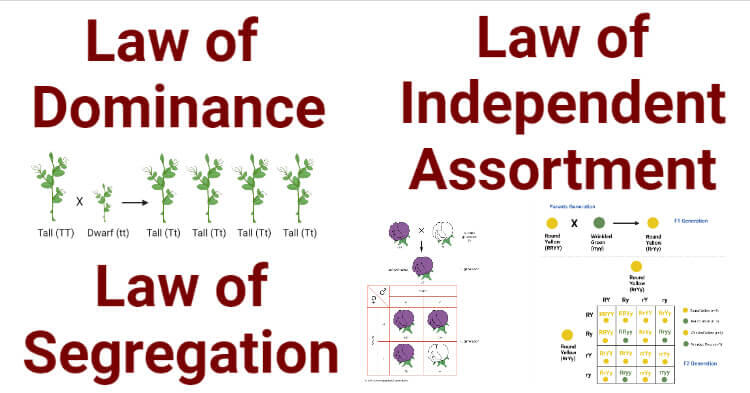
Mendel´s laws of inheritance:
Law of Segregation: Each inherited trait is defined by a gene pair. Parental genes are randomly separated to the sex cells so that sex cells contain only one gene of the pair. Offspring therefore inherit one genetic allele from each parent when sex cells unite in fertilization.
The Law of Independent Assortment: Genes for different traits are sorted separately from one another so that the inheritance of one trait is not dependent on the inheritance of another.
The Law of Dominance: An organism with alternate forms of a gene will express the form that is dominant.
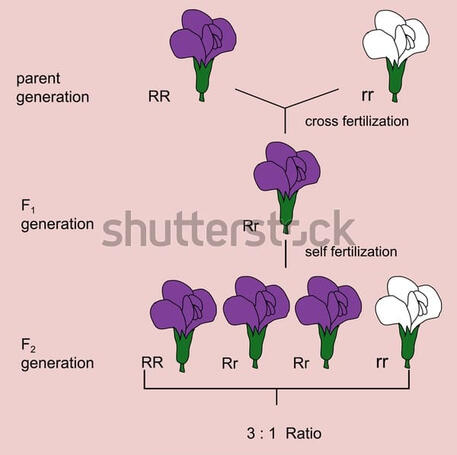
Steps to Mendel's experiments:
First he produced a parent generation of true-breeding plants. He made these by self-fertilizing the plants until he knew they bred true to the seven traits. For example, the purple flowering plants always produced seeds that made purple flowers. He called these plants the P generation (for parent).
Next, he produced a second generation of plants (F1) by breeding two different true-breeding P plants.
He then produced a third generation of plants (F2) by self-pollinating two F1 generation plants that had the same traits. Mendel's Results Mendel found some incredible results from his experiments.
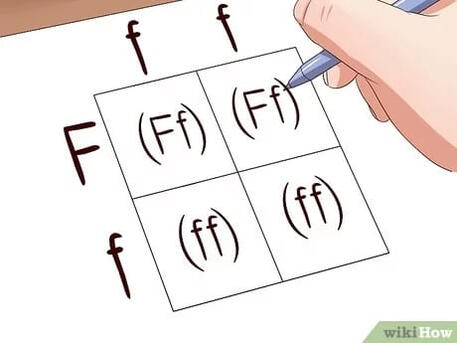
F1 Generation Mendel found that the F1 generation all produced the same trait. Even though the two parents had different traits, the offspring always had the same trait. For example, if he bred a P plant with a purple flower with a P plant with a white flower, all of the offspring (F1) plants would have purple flowers. This is because the purple flower is the dominate trait. These results can be shown in a diagram called a Punnett square. The dominate gene is shown with a capital letter and the recessive gene with a lower case letter. Here the purple is the dominant gene shown with a "P" and the white is the recessive gene shown with a "w."
F2 generation he found that 75% of the flowers were purple and 25% were white. Even though both parents had purple flowers, 25% of the offspring had white flowers. This turned out to be because of a recessive gene or trait was present in both parents. Here is the Punnett square showing that 25% of the offspring had two "w" genes causing them to have white flowers.
Next page: